Jakarta, 9 September 2026
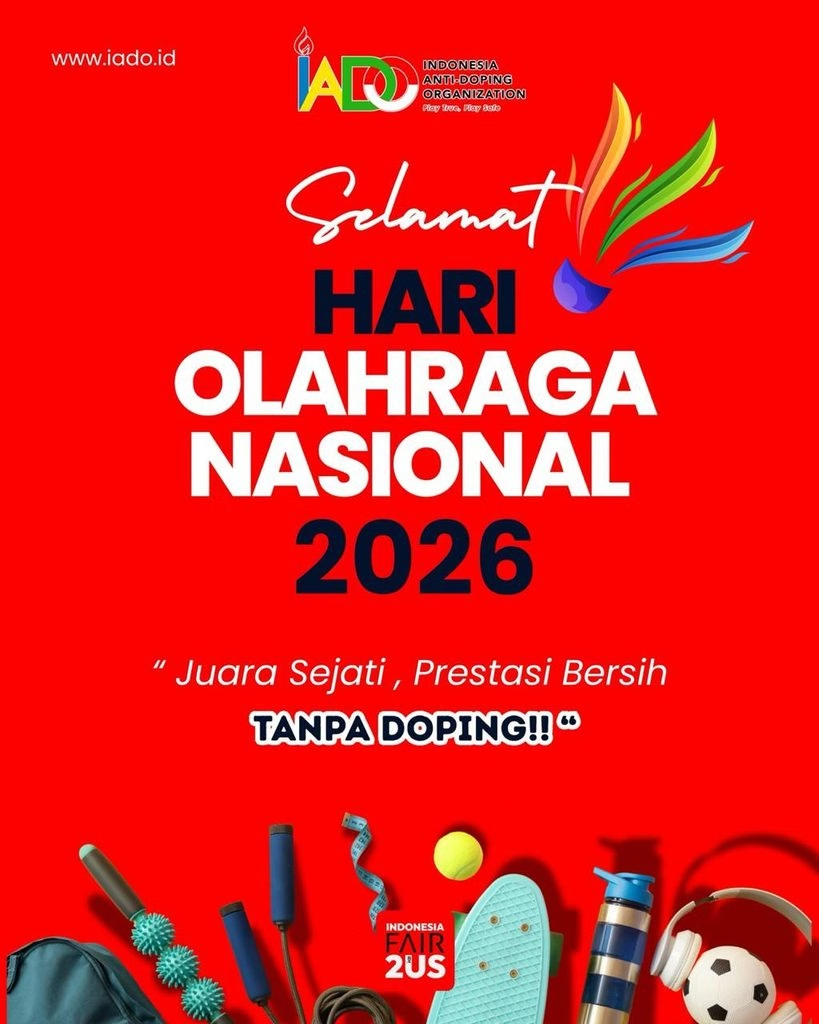
Many may have begun to forget that on September 9th, the entire nation of Indonesia used to commemorate the National Sports Day. This momentous occasion has a long history dating back to 1948. At that time, Indonesia intended to participate in its first Olympic Games in London. However, Indonesian athletes were rejected on administrative grounds because the Indonesian state had not yet gained widespread international political recognition. In response, the Chairman of the Indonesian Olympic Committee, Sri Sultan Hamengkubuwono IX in cooperation with the Sports Association of the Republic of Indonesia (now known as KONI) initiated the National Sports Games (PON) on September 9th, 1948, in Solo. The start date of the first PON in Solo was later designated by President Soeharto on September 9th, 1983, as National Sports Day (Haornas).
Time has passed, yet that historic momentum must not simply fade away. During every National Sports Day commemoration, IADO as the Indonesia’s sole national agency responsible for doping oversight consistently reminds us that the spirit to achieve excellence in international events must be heightened. This aligns with the aspirations of the founding fathers who boldly launched the first PON in Solo amidst the threat of military pressure from Dutch occupation forces, as well as the goals of today’s national sports stakeholders. Although doping controls were not implemented during the first PON, international sports entities had actually already instituted bans on stimulants; the IAAF (International Amateur Athletic Federation, which is now known as the International Association of Athletics Federations) became the first international federation to prohibit doping in 1928. Such prohibitions were subsequently expanded, notably during the 1968 Winter Olympic Games in Grenoble (France) and the Summer Olympic Games in Mexico.
Thus far, national sports stakeholders actually have been cooperative and understanding in adhering to all anti-doping regulations mandated by WADA. Both athletes and their support teams fully recognize the significant risks associated with rule violations, ranging from the imposition of sanctions and the revocation of championship titles to bans on competing in national and international events. One of the challenges faced by IADO is the need for more intensive anti-doping education, because many athletes and their support staff still do not fully realize that an anti-doping violation can be declared for reasons other than a positive laboratory test for a prohibited substance. Violations can also be established through actions such as evading sample collection, failing to undergo testing three times within a specific period, or causing another athlete to ingest a prohibited substance, such as surreptitiously administering a banned substance to ensure the other athlete tests positive. Ultimately, a true champion competes without doping. Once again, happy National Sports Day 2026.
Jakarta, 9 September 2026.
Chairman of IADO,
Gatot S. Dewa Broto